Writing this weekly email for the past eleven and a half years has not always been easy. Yet I’ve always felt a responsibility to share with you, my Aish family, what’s happening in our world. Sometimes the stories are enormous, sometimes they’re small, but each week I try to give you a glimpse into who we are, what we’re doing, and, most importantly, why it matters.
This week, a conversation moved me deeply. It reminded me of something fundamental about Aish that I think we sometimes overlook.
Many of you have heard me speak about the extraordinary reach of Aish, from the millions of Jews we engage online to our thriving educational programs in Israel. The numbers are impressive, but sometimes we become so focused on the scale of our work that we lose sight of the individual lives behind those numbers.
For more than a quarter century, Aish.com, under the extraordinary leadership of Editor-in-Chief Rabbi Nechemia Coopersmith, has served as a teacher, guide, and spiritual resource for Jews across the globe. I shudder to think what the spiritual response to October 7 would have looked like without Aish.com. Countless Jews, many of whom had never visited our website before, came searching for answers, meaning, and connection.

Years ago, our team began asking an important question. What happens to all those Jews who visit Aish.com and then leave? How do we engage them beyond the articles they read or the videos they watch?
Through conversations involving our professional team and our dear friends Bob and Michelle Diener, an idea emerged that became our live chat program.
Most websites are passive. You visit, you read, and you leave. We wanted to do something different. We wanted to reach out to people and ask a simple question: Can we help you?
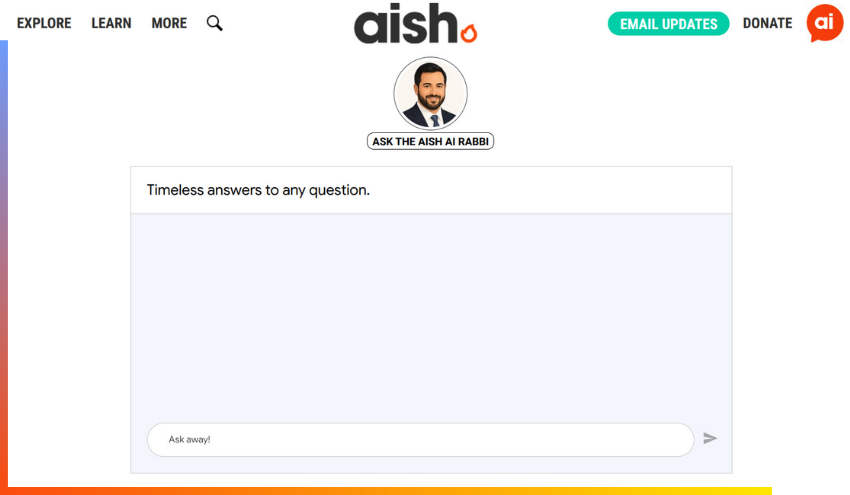
Rabbis stationed around the world became available to engage Jews in real conversations about Judaism, spirituality, and life’s most important questions. Over time, we introduced our AI Rabbi, providing immediate answers while ensuring that people seeking deeper engagement could connect with a live rabbi.
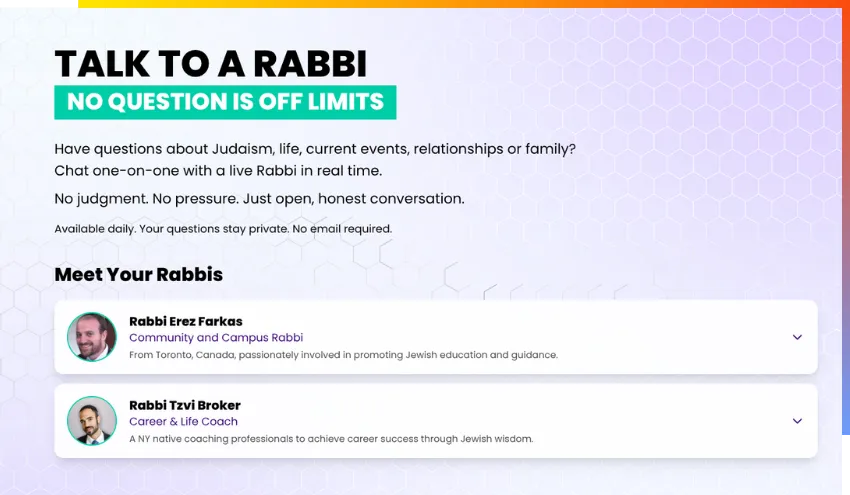
This remarkable effort has been championed and coordinated for years by Rabbi Tzvi Broker, an extraordinary individual whom I’ve been privileged to work with and learn from. Managing the enormous volume of incoming conversations, coordinating rabbis across different time zones, and ensuring that people receive thoughtful, meaningful responses is no small undertaking. Rabbi Broker has devoted himself to making sure that behind every chat is a genuine opportunity to connect with another Jew.
Recently, Rabbi Broker participated in a presentation to one of our longtime donors, together with members of our online educational team. The numbers were impressive, but what struck me most was how we measure success. We look at casual conversations, substantive conversations, and ultimately those moments when a virtual interaction leads to a real relationship, a class, or a connection with a Jewish community.
Our goal isn’t to keep every Jew within Aish forever. Sometimes someone comes to us for an answer, takes a class, or spends time studying in Jerusalem before continuing their Jewish journey elsewhere. We’re thrilled to help them take that next step, including connecting them with other wonderful Jewish organizations.
The presentation was so meaningful that we subsequently invited Rabbi Broker to speak to our development team about this extraordinary effort. Afterward, Rabbi Yaakov “Jack” Kalla, one of the first people I met when I arrived at Aish and someone who helped build Aish.com into what it is today, shared something with me personally that I haven’t stopped thinking about.
He told me that when the live chat program was first conceived, it had a very different name.
The Virtual Tap.
To understand what that means, you have to go back to the early days of Aish.
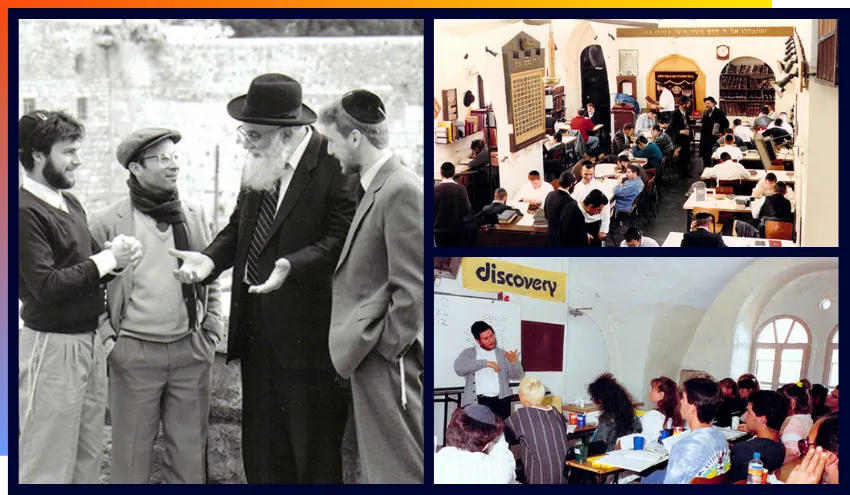
In the 1970s and 1980s, young Jews backpacked around the world searching for adventure, meaning, and often something they couldn’t quite define. Many eventually found themselves at the Western Wall in Jerusalem.
There, they might encounter a remarkable man named Rabbi Meir Schuster.
Rabbi Schuster was famously shy. In fact, he was probably the last person you would imagine approaching complete strangers. Yet he dedicated more than forty years of his life to doing exactly that.
There’s a beautiful story about how it all began. Rabbi Schuster and a friend once noticed a young backpacker standing at the Western Wall, visibly moved to tears. As the young man began to walk away, they realized that he had just experienced something profound, but had nowhere to turn to explore what it meant. Rabbi Schuster’s friend approached him, gently tapped him on the shoulder, and offered to help him learn more about Judaism.
That simple encounter helped launch a lifetime of reaching out to Jews at the Kotel.
Rabbi Schuster would approach people, sometimes opening with the simplest question: “Do you have the time?” From there, he might invite them to a Shabbat meal or a class at Aish, just a few steps away.
One small conversation could change the course of a Jewish life, and in many cases, the lives of generations to come. Rabbi Schuster’s story, and the story of those he inspired, even became a book published by Artscroll in 2021.

The world eventually changed. Young Jews were no longer arriving at the Kotel in the same way. Many were sitting thousands of miles away, searching for answers on their computers.
Rabbi Kalla explained to me that our team had realized something profound.
If people were no longer coming to the Western Wall to receive that tap on the shoulder, we needed to bring the tap to them.
That became the Virtual Tap.
A simple message appearing on someone’s screen. Can we help you? Do you have a question about Judaism? Would you like to speak with a rabbi?
Think about the beauty of that idea.
Rabbi Schuster stood at the Western Wall waiting for Jews to arrive. Today, we have the extraordinary ability to reach them wherever they are.
We can bring a little piece of the Western Wall into people’s living rooms. We can bring the warmth of Jerusalem into their homes. We can let Jews everywhere know that someone cares about them, that their questions matter, and that the doors of Jewish learning are open to them.
When Rabbi Kalla shared that story, I realized that this is exactly what Aish has always been about.
We are the people who tap others on the shoulder.
I remember being inspired years ago by Mr. Richard Horowitz, one of the great early heroes of Jewish outreach. Mr. Horowitz has helped countless young people travel to Israel to study in yeshivas and seminaries, often paying for their plane tickets himself.
He once told me that whenever he traveled, he carried extra Jewish books and educational materials. If he found himself sitting next to another Jew on an airplane, he wanted to have something meaningful to share.
He was always ready to offer that tap on the shoulder.
This week in Miami, I spoke with someone who has been studying with Aish and making remarkable strides in his Jewish journey. He described how so many Jews in his social circle in the financial world experienced their own October 7 awakening. People who suddenly began asking questions about their identity, their heritage, and what it means to be Jewish.
They’re searching, and our responsibility is to make sure someone is there to meet them.
At a time of unprecedented antisemitism, when so many Jews feel confused, isolated, or uncertain about their place in the world, we cannot afford to wait for people to find us.
We have to reach out. We have to offer that virtual tap.
It doesn’t require being a rabbi or a scholar. Sometimes it’s an invitation to a Shabbat meal. Sometimes it’s sharing an article, offering to study together, making an introduction, or simply letting another Jew know they’re not alone.
As we approach the end of our fiscal year, Aish will once again launch our annual All In For Aish campaign. I hope you’ll consider helping us continue this extraordinary work, including ensuring that our rabbis remain available to engage Jews around the world, one conversation at a time.

Yet I want to ask something even more important of you.
Who can you tap on the shoulder this week?
Who in your life might be waiting for someone to reach out? Who might be searching for something deeper but doesn’t know where to begin?
I’d love to hear your stories. Please respond to this email and tell me about a time when you reached out to another Jew, or when someone reached out to you and changed your life. Every response comes directly to my inbox, and I genuinely love hearing from you.
In fact, I’ve come to realize something else.
For eleven and a half years, this weekly email has been my own little virtual tap.
Every week, I sit down and try to reach out to all of you. Some weeks the words come easily. Other weeks, they don’t. Yet I keep writing because I know that somewhere in the world, someone might need that little tap on the shoulder. Perhaps a thought, a story, or a few words of encouragement will reach someone at exactly the right moment.
Over the years, I’ve been blessed to meet people around the world who have told me that something I wrote helped them, inspired them, or made them feel more connected to their Judaism. I cannot begin to tell you what that means to me.
It’s why I keep writing, week after week.
It’s why Aish exists.
Not simply to reach millions of people, but to reach one person. Then another. Then another.

If you can help support this mission, we would be deeply grateful. More importantly, every one of you can be part of this movement by reaching out to someone who might need that connection.
The next Jewish life that changes might begin with something as simple as a tap on the shoulder.
We are stronger together. We need one another now more than ever, and we have a responsibility to make sure that no Jew searching for connection feels they have to search alone.
May Hashem bless each and every one of you. From the bottom of my heart, I wish you and your families a beautiful, meaningful, and loving Shabbat Shalom.