I am writing at the end of what has been an extraordinarily busy week. It has also been an inspiring one. Despite the clouds that continue to hang over our region and the uncertainty surrounding Iran and its proxies, Jews are still coming to Israel. Missions are landing. Students are arriving. Families are visiting. Support continues to flow from every corner of the globe. The gates are open again, and people are walking through them with courage and faith. It is remarkable to witness.
We pray for peace to continue and to deepen. The Almighty runs the world, and our people have always faced history with resilience and faith. Whatever challenges emerge, we will confront them together, strengthened by Torah and by one another.
Many of you know that I often write. Writing is deeply personal for me. I carry many thoughts and emotions about the moment we are living in. I believe it is essential not only to teach Torah but to apply it to the world around us. When I write, I strive to express ideas that are rooted in Torah, aligned with Jewish wisdom, and responsive to the realities facing our people.
This past week, I wrote an article that generated more direct personal responses than anything I have written before. I am grateful for that. I encourage you to reply to this email. I read every response. I write this weekly message myself. Others may glance at it for grammar, but the voice, the perspective, and the responsibility are mine alone. When you reply, you are writing directly to me. In a global movement as vibrant and expansive as Aish, maintaining that open line of communication is very important to me.
The article addressed the painful incident in Bnei Brak where Israeli soldiers were accosted by local youth. The images were deeply embarrassing and profoundly hurtful. Across the spectrum of responses I received, one common theme emerged. No matter where people stood ideologically, they felt sadness and disappointment that Jewish youth could behave in a way so out of step with our values. That shared pain is significant. It reminds us that beneath our disagreements there remains a common heart.
For the past two-and-a-half years, our focus has largely been external. The IDF has fought with extraordinary bravery. The word heroes feels too small for what so many of these young men and women have done. They have defended our people, pursued our enemies, brought hostages home, and in too many cases given the ultimate sacrifice. Through courage and Divine guidance, major threats from Hamas, Hezbollah, Iran, and their proxies have been significantly weakened.
As we move into a period where that singular external focus is less intense, the internal dynamics become more pronounced. That transition can be difficult. I confess that I am concerned. I see fault lines emerging. I see polarization intensifying. I see rhetoric hardening.
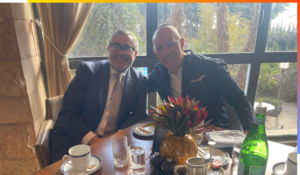
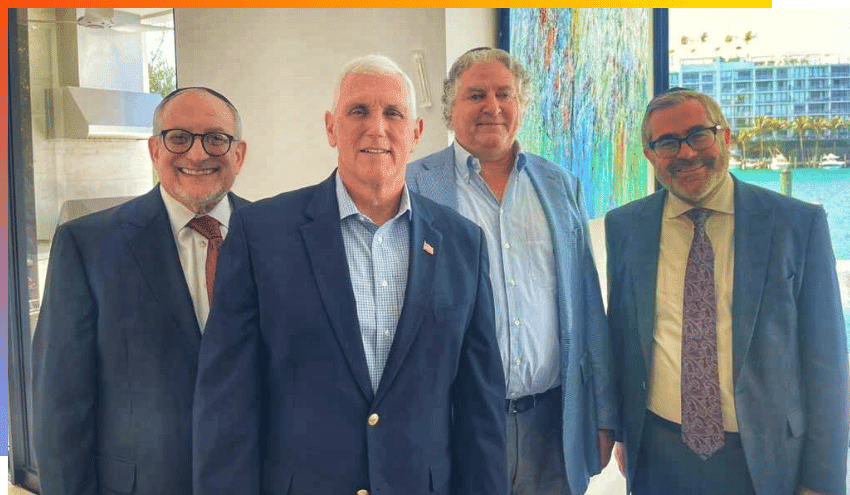
This week also included a meaningful and important meeting that connects directly to these themes of unity, relationship, and standing proudly for Israel. Rabbi Meyer May, our Executive Vice President, and I had lunch with the Falic family, together with former Vice President Mike Pence. Many of you may recall that Vice President Pence visited Aish while serving in office and has consistently been one of the strongest friends of Israel in American public life.
It was an honor to be present. The Falic family has stepped forward in a powerful way to defend Israel and the Jewish people. Hosting a private luncheon in support of Advancing American Freedom and continuing to stand publicly with leaders who have championed Israel reflects a deep sense of responsibility. True friendship is measured not only when someone holds office, but when the spotlight fades. Remaining close, maintaining relationships, and supporting those who have stood by the Jewish people is both wise and principled.
The opportunity to sit together, to speak about Israel, about the Jewish future, and about the moral clarity required in today’s world was deeply meaningful. We must cultivate friends. We must strengthen alliances. We must show appreciation to those who have advocated for us. At the same time, we must ensure that our own internal unity matches the strength of the support we seek from the outside.
Elections in Israel often magnify tensions. People retreat into camps. Voices grow louder. Language becomes sharper. It is precisely at such moments that Aish’s mission becomes even more essential.
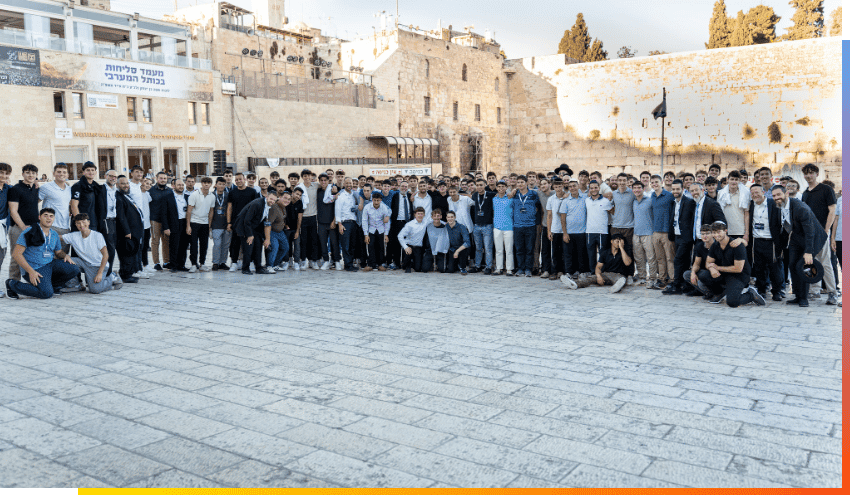
Aish has always been open to every Jew. Our core values are wisdom, love, and responsibility. We do not belong to a political camp. We belong to the Jewish people. Some attempt to place us in a box. Some insist we are too this or not enough that. We have relationships across the political spectrum in Israel and around the world. Recently, an individual identified with the far left visited our rooftop. We learned Torah together before he went to the Western Wall. Some questioned why we would engage. My answer is simple. How could we not?
If we cannot sit with another Jew and learn Torah, even when we disagree deeply, then who are we? Dialogue is not endorsement. It is an expression of confidence in the power of Torah and in the bonds of Jewish destiny.
I often quote something my father, of blessed memory, would repeat in the name of Rabbi Dr. Norman Lamm zt’l. He would say that he did not like every Jew, but he loved every Jew. I understand that sentiment profoundly. There are Jews with whom I disagree strongly. There are positions I find troubling. There are behaviors I wish were different. Yet my love for Jews is unwavering. I love seeing a Jew on an airplane and exchanging a knowing glance. I love spotting someone putting on tefillin in a quiet corner of an airport. Someone once told me that being a Jew is like being a secret agent. We are often doing something distinct, something countercultural, something holy in the midst of the ordinary. We recognize one another even when no one else does.
That recognition carries responsibility.
In 2024, there was footage of Chabad emissaries at an anti-Israel rally helping a protester wearing a keffiyeh put on tefillin. Some mocked it. I found it inspiring. That is love in action. It is easy to embrace the Jew who already agrees with you. It is much harder to embrace the Jew who stands on the other side of a barricade. Yet that is precisely where our greatest work lies.
I was recently with one of our cherished Aish supporters, David Moore, a dear friend and remarkable partner in our mission. He found himself in conversation with a very high-profile individual who has been publicly critical of Israel. Instead of dismissing him, David engaged him in a thoughtful forty-five-minute conversation. That individual listened carefully. He did not immediately transform into a public advocate. He did not suddenly wrap himself in blue and white. Yet shortly afterward, he began clarifying some of his previous statements in a more nuanced way. Seeds were planted. A door was opened.
When David told me about that exchange, I felt blessed to call him my friend. Each of us has a role to play at this moment. We cannot afford to retreat into our own echo chambers. The world would love nothing more than to watch Jews fracture from within. We must deny them that satisfaction.
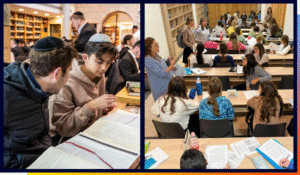
This is the hour to double down on love. This is the hour to deepen Torah learning across every segment of our people. This is the hour to take responsibility not only for our own spiritual growth but for the unity of our nation.

The Second Temple was destroyed because of baseless hatred among Jews. That lesson reverberates through history. If hatred could destroy, love can rebuild. If division could exile us, unity can redeem us.
We are the children of the Almighty. He loves us with infinite love. Our task is to reflect that love toward one another, especially when it is difficult, when emotions run high, and when elections loom and debates intensify.
Am Yisrael Chai is not merely a slogan. It is a commitment. It is a declaration that the Jewish people live through faith, through courage, and through love. If we strengthen those bonds, if we choose engagement over estrangement, if we see one another first as brothers and sisters before anything else, then we will merit not only security and stability, but spiritual renewal.
May we see the day when unity replaces suspicion, when love overcomes anger, and when our collective strength helps rebuild what was once lost.